

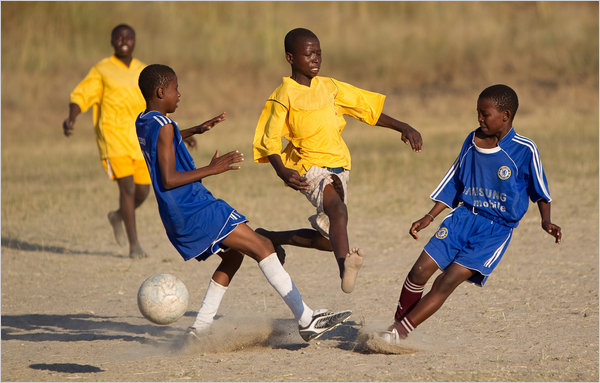
Walk into a dusty football pitch in Nairobi, Accra, Lagos, Dakar or Abidjan and you may be looking at a future millionaire.
Stand beside a rural athletics track in Kenya, Ethiopia or Uganda and a future Olympic champion could be running past you.
Visit a boxing gym in Kampala, a basketball court in South Sudan, a cycling community in Rwanda or a school tournament in Morocco and the same truth emerges: Africa is sitting on one of the world's richest deposits of sporting talent.
Yet unlike oil, gold or diamonds, this resource walks.
And when opportunity does not arrive, it can walk straight out of the continent.
That should concern African governments.
Because while much of Africa continues to treat sport as recreation, ceremony or an occasional source of national pride, much of the developed sporting world treats it as something else entirely:
An industry.
More than 200 scouts came looking
Perhaps one of the clearest demonstrations of Africa's sporting value unfolded at the 2025 CAF Under-17 Africa Cup of Nations in Morocco.
According to the Confederation of African Football, more than 200 scouts were officially accredited to the tournament, with European clubs dominating the contingent.
They represented some of the biggest names in world football, including Manchester United, Liverpool, Chelsea, Bayern Munich, Atlético Madrid, Benfica, Porto, Monaco and Marseille.
Think about that for a moment.
Hundreds of professional talent evaluators crossed continents to watch African teenagers play football.
They did not travel to Africa as tourists.
They came because they understood that somewhere on those pitches could be tomorrow's centre-back, striker, goalkeeper or midfielder worth millions.
That is a lesson African policymakers should study carefully.
When outsiders are travelling thousands of kilometres to inspect what is growing in your backyard, perhaps it is time to ask whether you fully understand the value of what you have.
Europe understands the economics
The movement of African football talent towards Europe is hardly new.
Research has documented for decades how academies and football networks across Africa have become intertwined with the migration of players into European leagues. More recent research examining professional African footballers who played across more than 30 European leagues similarly illustrates how international mobility has become deeply embedded in African football careers.
None of this means African athletes should be prevented from going abroad.
Quite the opposite.
A talented footballer from Kisumu should be free to play in Madrid. A runner from Eldoret should be free to compete wherever professional opportunity takes them. A basketball player from Dakar should be able to pursue the NBA.
International sport can transform athletes' lives and provide income for families and communities back home.
The uncomfortable question is different.
Why must leaving Africa so often appear to be the point at which African talent finally receives world-class investment?
Why should the exceptional young footballer need Europe before gaining elite facilities?
Why should the promising athlete struggle for sponsorship until an international competition suddenly makes their name valuable?
Why are promising sportsmen and women sometimes treated as dreamers at home but as investment opportunities abroad?
That is the contradiction Africa must confront.
An athlete is not just an athlete
Governments frequently talk about creating jobs for young people.
Yet sport itself can create entire economic ecosystems.
Think beyond the person kicking the football.
Around one successful professional league are coaches, physiotherapists, photographers, journalists, commentators, graphic designers, security officers, doctors, nutritionists, marketers, referees, groundskeepers, data analysts, ticketing companies, broadcasters and equipment suppliers.
There are hotels.
Transport companies.
Restaurants.
Betting and gaming businesses.
Merchandising companies.
Sportswear manufacturers.
Digital content creators.
Advertising agencies.
Academies.
Stadium workers.
Lawyers and player agents.
Sport therefore should not simply appear in a national budget as money spent entertaining young people.
It should increasingly be discussed alongside tourism, the creative economy, broadcasting and youth employment.
A country that produces world-class athletes but fails to build an industry around them is like a country exporting raw cocoa and later importing expensive chocolate.
The talent was always valuable.
Someone else simply understood how to process it.
Africa celebrates champions. But who develops them?
This is perhaps the biggest challenge.
African countries are extraordinarily good at celebrating winners.
An athlete returns with a medal and suddenly there are flags at the airport, television cameras, congratulatory messages, government officials and sometimes cash rewards.
But an uncomfortable question should be asked before the applause:
Where was everybody when that athlete was 15?
Where were the nutritionists?
Where was the sports psychologist?
Where was the physiotherapist?
Where was the scholarship?
Where were the quality running shoes?
Where was the professional coach?
Where was the medical insurance?
Where was the data analyst measuring performance?
Where was the federation when the athlete needed to travel to a qualifying event?
If a country invests heavily only after an athlete becomes successful, it is not developing talent.
It is celebrating finished products.
Africa must become obsessed with the stage before the medal.
Changing nationality should make Africa think
Athletics provides another complicated dimension to the debate.
World Athletics maintains formal procedures governing transfers of allegiance, and its records continue to show athletes moving between national federations.
Some African-born athletes have consequently represented countries outside the continent.
Their individual decisions should not automatically be condemned.
Athletes have careers that can be remarkably short. They have families, financial obligations and personal ambitions. If another sporting system provides better coaching, income, facilities, medical support or opportunities to compete, choosing that system may be completely rational.
The more useful question is not:
“Why did the athlete leave?”
It is:
“What conditions made leaving more attractive than staying?”
That changes the debate from blaming sportsmen and women to examining sporting institutions.
If another country can identify an African athlete, invest in them and eventually benefit from their performance, African governments should be capable of doing the same.
Talent migration should therefore be treated partly as feedback.
Sometimes the athlete is telling the system something simply by leaving it.
Footballers should not have to escape Africa to become valuable
The language commonly used around African football is itself revealing.
Young players dream of being "spotted".
They dream of "going abroad".
Families sometimes view European football almost as a lottery ticket.
That aspiration is understandable when European leagues represent the highest levels of competition and enormous earning potential.
But Africa should simultaneously ask why its domestic leagues cannot capture considerably more value.
Imagine stronger national leagues with reliable broadcasting contracts.
Imagine properly marketed club rivalries.
Imagine full stadiums with safe ticketing systems.
Imagine professionally operated academies connected to schools.
Imagine clubs retaining meaningful commercial interests in the players they develop.
Imagine women's leagues receiving serious broadcast and sponsorship investment.
Imagine former athletes becoming coaches, academy owners and sporting entrepreneurs.
Then the export of exceptional players becomes part of a functioning industry rather than the industry's entire business model.
Africa does not need to stop producing players for the Premier League, La Liga, Serie A or Bundesliga.
It needs to become much better at benefiting from the economic journey that begins before those players arrive there.
Women's sport may be an even bigger opportunity
The next sporting gold mine may not even be men's football.
African women's football, athletics, rugby, basketball, cycling, boxing and other sports contain enormous room for growth.
Consider cycling.
Team Amani, formed in 2025 with women from countries including Ethiopia, Uganda and Rwanda, is working towards competing at the Tour de France Femmes. Yet its push into elite European competition has also highlighted familiar difficulties: limited resources, inadequate staffing and the search for major sponsorship.
The talent exists.
The ambition exists.
What is often missing is the financial architecture around it.
That gap is an investment opportunity hiding in plain sight.
There are signs Africa is waking up
The picture is not entirely bleak.
CAF has increasingly pushed structured youth development, including its African Schools Football Championship. Research conducted through the competition during the 2025/26 cycle examined talent identification, long-term player development and the support environments surrounding young footballers.
African Olympic institutions are also investing.
In 2026, the Association of National Olympic Committees of Africa announced a $2 million athlete-support programme towards the Los Angeles 2028 Olympic Games, covering areas including quality training facilities, coaching, medical care, insurance, accommodation and qualification-event support.
Those initiatives point towards the right idea.
Elite sporting performance does not happen because somebody happens to be naturally gifted.
Talent is the beginning.
Systems create champions.
Build academies before monuments
African governments therefore need to reconsider what sporting investment looks like.
It is politically attractive to build a large stadium.
People can see it.
Politicians can open it.
Television cameras can film it.
But sporting development requires far less glamorous investments too.
Community pitches.
School competitions.
Qualified coaches.
Talent databases.
Sports medicine.
Nutrition programmes.
Equipment.
Athlete insurance.
Psychological support.
Local leagues.
Women's competitions.
Transparent federations.
Commercial sponsorship structures.
University sporting scholarships.
And pathways that allow a gifted 12-year-old in a remote village to eventually reach elite competition without needing wealthy parents or extraordinary luck.
A stadium without a talent-development system can become an expensive concrete shell.
A functioning development system, however, can continually produce athletes who fill stadiums.
Africa's next great export should be sports brands
There is nothing inherently wrong with African athletes becoming international stars.
Mohamed Salah becoming a global football icon does not diminish Egypt.
African runners dominating international races strengthens the continent's sporting reputation.
African basketball players reaching the world's biggest leagues can inspire millions of children.
The ambition should therefore not be to imprison talent within national borders.
It should be to build African institutions powerful enough to participate economically in that success.
Africa should produce globally recognised clubs.
African academies should become internationally respected brands.
African leagues should command serious broadcasting rights.
African sporting events should attract global tourism.
African sportswear companies should sponsor African champions.
African media companies should own valuable sporting content.
African universities should develop world-class sports science programmes.
And African investors should look at the talented teenager on a dusty field and see what a European scout already sees:
an asset worth developing.
The gold is already here
For generations, Africa's economic story has included the export of valuable raw materials followed by the importation of expensive finished products.
Sport risks repeating that history in human form.
The continent produces the raw talent.
Someone else provides the elite development environment, marketing machine, professional league and commercial platform.
Then Africa watches its own brilliance on television.
That model must change.
Not by preventing young Africans from pursuing global opportunities, but by making sure that the continent which discovers, raises and inspires them also builds institutions capable of developing and benefiting from their success.
Africa does not have a shortage of sporting talent.
It has Kenyan runners.
Moroccan footballers.
Nigerian strikers.
South African rugby players.
Senegalese footballers.
Ugandan athletes.
Ivorian footballers.
Ethiopian distance runners.
Ghanaian players.
Cameroonian stars.
Rwandan cyclists.
And millions more whose names the world has not yet heard.
The real shortage is the infrastructure, investment and imagination required to turn that enormous human potential into a sustainable African industry.
Oil can run dry. Mines can be exhausted.
But every year, another generation of African children begins running, kicking, boxing, swimming, cycling and dreaming.
That may be one of the continent's greatest renewable resources.
It is time Africa started treating it like one.









Comments (0)
No comments yet. Be the first to comment!
Leave a Comment