

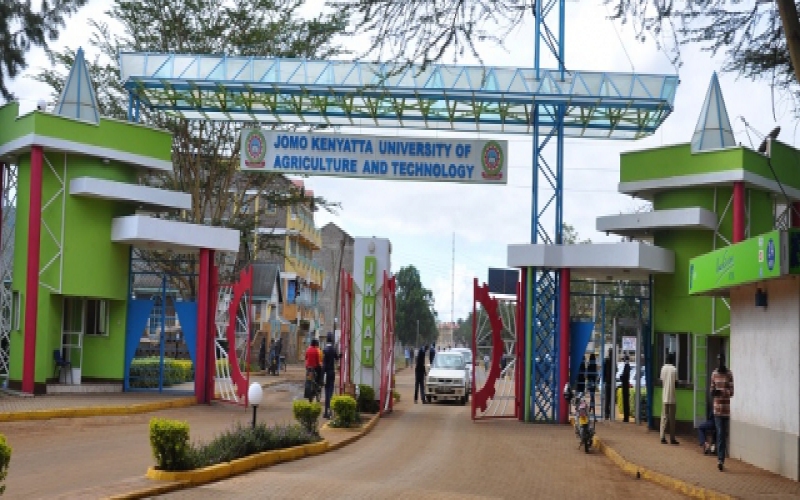
Kenyan student innovation is challenging the assumption that advanced artificial intelligence must be expensive, complicated or designed exclusively for large corporations.
At the centre of the breakthrough is Ridan Hawi, a fourth-year engineering student at Jomo Kenyatta University of Agriculture and Technology (JKUAT), who joined forces with Rodgers Hawona of Kirinyaga University and Robert Odhiambo of the University of Nairobi to develop LINDA, an AI-powered safety assistant for workers in Kenya’s informal sector.
Operating under Team DuniAfrika, the three innovators created a system that allows artisans, mechanics, welders, construction workers and other labourers to identify dangers within their workplaces using WhatsApp.
A worker can photograph a suspicious machine, exposed electrical wiring, an unstable structure or another potentially hazardous situation and send the image to LINDA. The system analyses the photograph, identifies possible risks and delivers immediate safety recommendations in either English or Kiswahili.
Workers can also send written questions about workplace safety. LINDA responds with practical guidance designed to help them make safer decisions before an accident occurs.
The invention propelled Team DuniAfrika to victory in the 2025 Call for Code Global Challenge, where it emerged from more than 29,000 entries submitted from across the world. The team became the first from Africa and the Middle East to secure the competition’s global grand prize since the initiative was launched in 2018.
For JKUAT, Hawi’s achievement provides another powerful demonstration of what can happen when engineering education is connected to the everyday problems confronting society.
Instead of developing technology for a distant or imagined market, the team turned its attention to Kenya’s vast jua kali economy—a sector that supports millions of livelihoods but where many people work without safety officers, structured training or reliable access to occupational-health information.
A mechanic working beneath a vehicle, a welder handling electrical equipment or a construction labourer operating near an unstable structure may recognise that something appears unsafe without knowing the precise danger or the appropriate precautions. LINDA is intended to place basic safety guidance within immediate reach.
The project uses IBM Granite artificial intelligence models to process both images and text. Its vision technology examines workplace photographs for dangers such as missing protective equipment, exposed cables, unstable structures and unsafe machinery. Its language system then translates the findings into clear, context-sensitive recommendations.
Significantly, the developers built the service around WhatsApp rather than requiring workers to download and navigate an unfamiliar application. That design decision could make the system more accessible to users who have smartphones but limited exposure to specialised digital platforms.
IBM had previously recognised DuniAfrika as a first-place team in its Lean AI Solutions Hackathon, praising LINDA’s ability to deliver personalised workplace-safety guidance through a communication platform already familiar to its intended users.
The idea was inspired partly by a workplace accident involving the parent of one of the team members. That experience helped the students recognise that many serious injuries might be avoided if workers could identify hazards early and receive reliable guidance before proceeding with a dangerous task.
The innovation consequently presents artificial intelligence not as a substitute for workers, but as a protective tool placed directly in their hands.
Its success is also an important moment for JKUAT’s reputation in engineering and technological training. Hawi’s participation demonstrates the capacity of the university’s students to collaborate beyond institutional boundaries, compete against innovators internationally and apply advanced technology to challenges rooted in Kenyan communities.
The achievement is particularly notable because the winning team brought together students from three different Kenyan universities. It provides a compelling example of how cross-university collaboration can combine diverse technical abilities instead of confining innovation within individual campuses.
Winning an international competition, however, is only the beginning. LINDA will still require further testing, continuous improvement and collaboration with occupational-safety specialists to ensure that its recommendations are dependable in different working environments.
Questions of internet access, data protection, the accuracy of AI-generated advice and responsibility for incorrect recommendations will also have to be carefully addressed as the technology moves towards wider adoption.
Yet its promise is difficult to ignore.
LINDA demonstrates that some of Africa’s most meaningful technological ideas may not emerge from attempts to imitate products built elsewhere. They may come from students who understand local problems, recognise the limitations facing ordinary workers and develop solutions around the tools people already use.
For Hawi and his fellow innovators, the global prize is recognition of an impressive technological achievement. For JKUAT, it is evidence that its engineering students can compete on the world stage. For Kenya’s jua kali workers, LINDA could eventually become something even more important: a digital safety companion capable of warning them before an ordinary working day turns into a life-changing accident.
Tags
University Diploma vs TVET Diploma: Two Roads, One Destination — Understanding the Difference Without the Myths
How JKUAT Students Led Kenya to Historic First Win at Huawei Global ICT Competition









Comments (0)
No comments yet. Be the first to comment!
Leave a Comment