

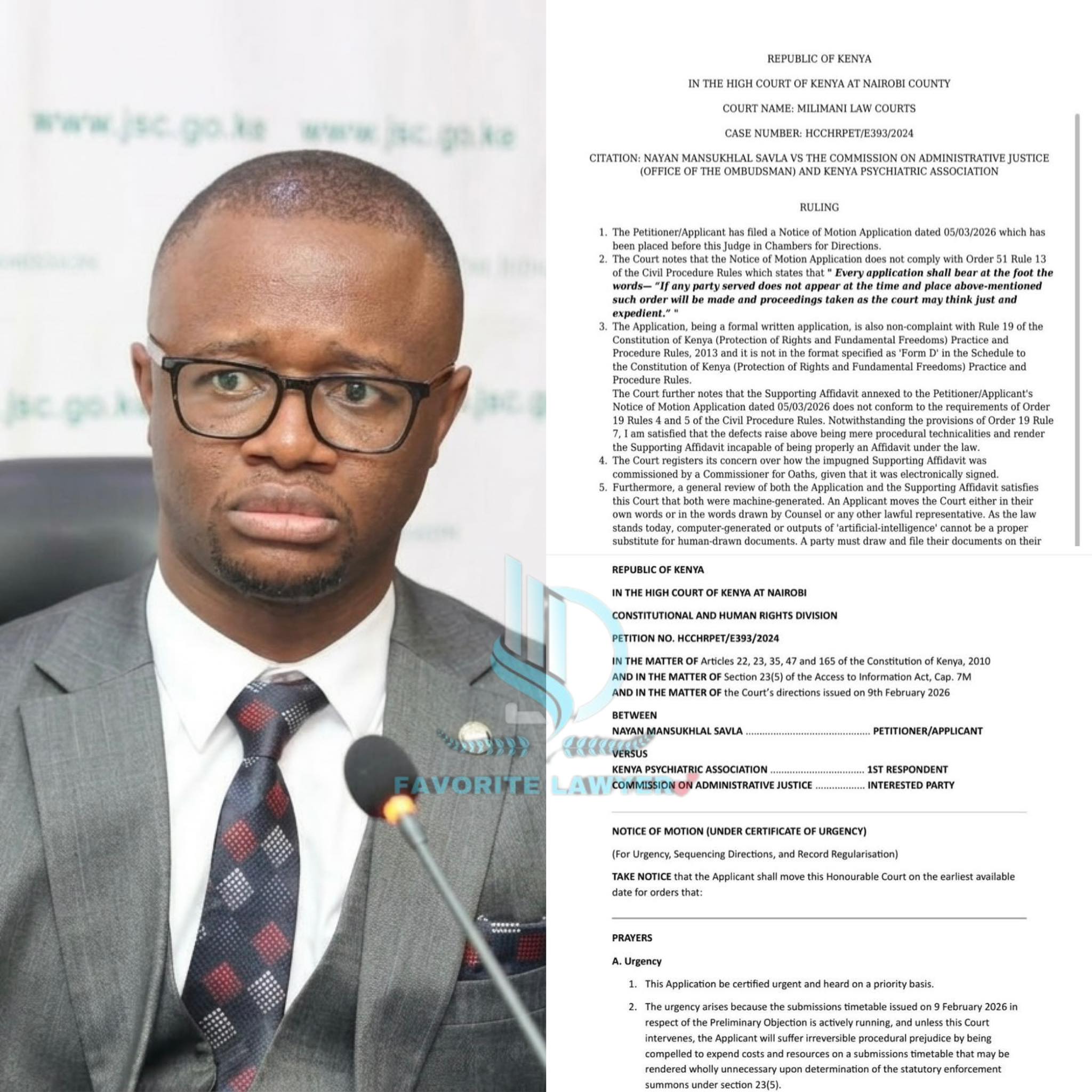
A High Court judge has sent a powerful warning about the careless use of artificial intelligence after striking out a court application that had been generated using AI.
In a decision that is already sparking debate in legal and technology circles, High Court Judge Bahati Mwamuye reportedly rejected the application after discovering that the document had been produced by artificial intelligence instead of being properly drafted by the petitioner.
The judge did not hold back.
Justice Mwamuye ordered the petitioner to withdraw the defective filing and submit a fresh application written properly and in compliance with the law, specifically citing provisions under the Civil Procedure Rules, including Order 51 Rule 13 and Order 19 Rules 4 and 5.
According to the court, the problems in the application were so serious that they could not even be corrected.
“The defects cannot be cured by amendment,” the judge ruled.
In simple terms, the document had to be completely thrown out.
AI Is a Tool — Not a Substitute for Legal Work
The ruling highlights the growing tension between rapid technological innovation and the strict procedural requirements of the legal system.
Artificial intelligence tools are increasingly being used to draft documents, summarize legal texts, and assist professionals across many fields. However, the court’s decision demonstrates that blindly copying and filing AI-generated content without verification can have serious consequences.
Legal experts say that court documents must follow precise formats, sworn statements, and procedural rules, and any errors can invalidate the entire application.
Every word submitted to a court carries legal weight.
When the rules are ignored, the justice system is not obliged to correct the mistakes.
A Wake-Up Call for Professionals Using AI
The case is likely to serve as a wake-up call for lawyers, litigants, students, and professionals who increasingly rely on AI tools when drafting documents.
Technology can assist research, improve efficiency, and even help structure arguments. But experts caution that AI should only be used as a supporting tool — not as a final authority.
Documents generated through artificial intelligence must always be reviewed, edited, and verified by human experts before being submitted in official processes.
Failure to do so can lead not only to embarrassment but also to serious legal setbacks, as seen in this case.
Procedure Remains the Backbone of Justice
The court’s decision reinforces a long-standing principle in law: procedure is not a mere technicality — it is the backbone of justice.
No matter how advanced technology becomes, legal systems around the world still depend on careful drafting, compliance with procedural rules, and professional accountability.
As artificial intelligence continues to reshape workplaces and industries, the message from the High Court is clear:
Use AI wisely — but always read, verify, and take responsibility for what you submit.
Because in the courtroom, a shortcut can cost you the entire case.
Tags














Comments (0)
No comments yet. Be the first to comment!
Leave a Comment