

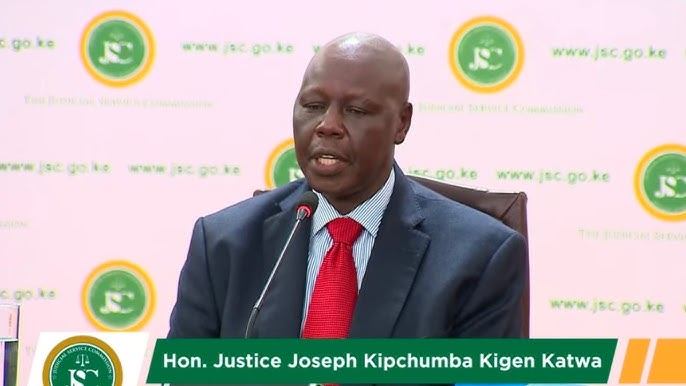
Court of Appeal Judge Joseph Katwa Kigen walked into his Supreme Court interview facing one of the most politically sensitive questions before the Judicial Service Commission: can a former lawyer of President William Ruto be trusted to sit fairly in a court that may one day determine a presidential election dispute?
But instead of running away from the issue, Kigen confronted it directly, calmly and with a tone that appeared designed to disarm the panel.
Appearing before the JSC on Tuesday, Kigen was pressed over his previous legal representation of President Ruto, including his role in the International Criminal Court matter and the 2022 presidential election petition. Concerns had been raised that his past professional links with the President could compromise his independence if appointed to the Supreme Court.
The question became sharper because the Supreme Court is the final court in presidential election petitions. With Kenya heading toward another general election in 2027, commissioners wanted to know whether Kigen would remain impartial if a dispute involving President Ruto landed before the apex court.
Kigen’s answer was carefully measured.
He admitted the relationship openly, but immediately separated his past work as an advocate from his current duty as a judge. He told the panel that it was true he had represented Ruto, but insisted that his judicial decisions would be guided strictly by facts and the law.
That was the first way he outsmarted the panel: he did not deny the obvious.
Rather than treating the question as an attack, Kigen acknowledged the public concern and presented himself as a judicial officer aware of the sensitivity of the matter. According to sources, he said he understood the concerns and could not dismiss them as ill-informed, but assured the commission that he would remain fair, objective and neutral.
His second move was to turn the concern into a broader principle: lawyers should not be punished for having represented clients before joining the bench.
Kigen argued that using his past legal work against him would border on discrimination, noting that many judges previously acted for different clients before appointment to judicial office. In effect, he asked the panel to judge him by his integrity, fairness and commitment to the law, not by the identity of a former client.
His third move was to point to existing safeguards in the judicial system.
Kigen reminded the panel that where a real conflict of interest arises, a judge can recuse himself from a case. He also noted that the Supreme Court’s work is not limited to presidential election petitions and that some presidential disputes have previously proceeded without the full seven-judge bench.
That response allowed him to avoid appearing desperate for the seat while also reassuring the commission that the Judiciary already has mechanisms for handling possible conflicts.
Beyond the Ruto question, Kigen also had to respond to concerns about timing. Chief Justice Martha Koome questioned why he was seeking elevation to the Supreme Court only about three months after being appointed to the Court of Appeal, saying that under normal human resource practice, one would usually remain in a position long enough to be evaluated.
Kigen defended his suitability by pointing to his broad experience in local and international legal practice. His supporters are likely to read his performance as that of a man who understood the political weight of the questions but refused to be dragged into political defensiveness.
What stood out most was his humility in tone.
He did not present himself as a victim. He did not attack those who raised the concerns. He did not dismiss the panel’s questions as unfair. Instead, he accepted that the concerns were legitimate in the eyes of the public, then calmly explained why they should not automatically disqualify him.
That approach may have been his strongest weapon.
In a country where judicial appointments often attract political suspicion, Kigen appeared to understand that the interview was not just about legal qualifications. It was also about public confidence, perception and institutional trust.
By admitting his past ties, promising neutrality, invoking the law, and pointing to recusal as a safeguard, Kigen managed to turn a potentially damaging question into a test of judicial temperament.
Whether the JSC will be convinced remains to be seen. But for a candidate facing one of the most politically delicate questions in the interview room, Kigen’s strategy was clear: concede the facts, lower the temperature, and remind the panel that a judge is ultimately bound not by former clients, but by the Constitution and the law.














Comments (0)
No comments yet. Be the first to comment!
Leave a Comment