

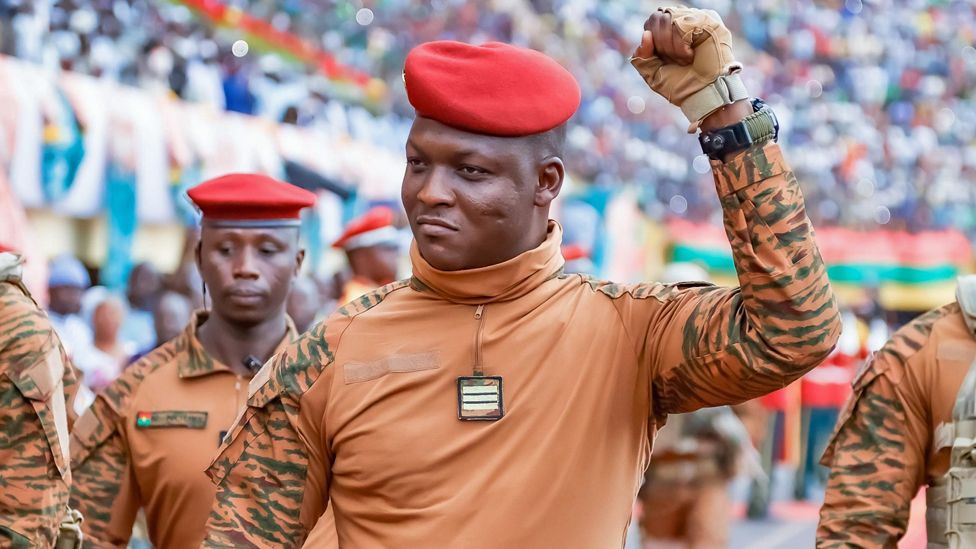
In a continent often defined by long-standing political figures and deeply entrenched systems, the rise of Burkina Faso’s President, Ibrahim Traoré, has captured the imagination of a generation.
At just 30s, Traoré did not emerge from elite political circles or decades of party politics. He came from the military—a young officer shaped by the harsh realities of conflict in the Sahel. His journey to power was not gradual; it was sudden, decisive, and reflective of a nation growing impatient with insecurity and stagnation.
When he took over leadership in 2022, following a coup that removed a government struggling to contain insurgency, Traoré stepped into office at a time when Burkina Faso was facing one of its most difficult chapters. Armed groups controlled large parts of territory, public confidence in leadership was low, and the future appeared uncertain.
Yet, in that moment of crisis, a young leader chose to step forward.
His story is not simply about how he gained power—it is about what his rise represents.
For many young Africans, Traoré embodies a shift. He represents a break from the idea that leadership must be slow, aged, and disconnected from the realities of ordinary citizens. His presence at the helm signals that youth, when combined with conviction, can step into spaces once thought unreachable.
Across the continent, where millions of young people navigate unemployment, limited opportunities, and political exclusion, his ascent has ignited conversations: If leadership can change in Burkina Faso, what is possible elsewhere?
Traoré has positioned himself as a voice of sovereignty and self-reliance, echoing sentiments long held but rarely acted upon with such urgency. He has spoken of the need for African nations to define their own paths, to rely on their own resources, and to build systems that serve their people first.
In many ways, his leadership has drawn comparisons to past revolutionary figures who sought to redefine Africa’s place in the world. But unlike those figures, Traoré operates in a digital age—where every move is scrutinized, every decision amplified, and every narrative contested.
His leadership is therefore both symbolic and practical.
Symbolic, because he represents a generation demanding change.
Practical, because he must deliver results in a country still battling insecurity and instability.
This dual responsibility defines his presidency.
For young leaders watching from across Africa—including Kenya—there are important lessons to draw from his journey.
First, leadership is not always about waiting for the “right time.” Sometimes, it is about recognizing a moment and stepping into it with courage.
Second, influence is not determined solely by age or status, but by the ability to respond to the needs of the people. Traoré’s rise was fueled by a perception that existing leadership had failed to address urgent challenges.
Third, vision matters. In times of uncertainty, people gravitate toward leaders who offer direction—even if the path is difficult.
However, his story also carries a caution.
Leadership achieved quickly must be sustained carefully. The expectations placed on him are immense, and the challenges he faces are complex. Transforming a nation requires not only bold ideas, but also stability, inclusivity, and trust.
For young Africans inspired by his journey, the lesson is not simply to seek power—but to prepare for responsibility.
In Kenya, where youth form the majority yet often feel sidelined in decision-making, Traoré’s story resonates deeply. It challenges young people to rethink their place in leadership—not as future participants, but as present contributors.
It also challenges institutions to open space for new voices, new ideas, and new approaches.
Ultimately, Ibrahim Traoré’s story is still unfolding. Whether he will be remembered as a transformative leader or a transitional figure remains to be seen.
But one thing is clear: his rise has already shifted perceptions.
It has shown that leadership in Africa is not fixed—it is evolving.
And for a generation watching closely, it offers a powerful reminder:
the future of leadership on the continent may arrive sooner—and younger—than expected.






Comments (0)
No comments yet. Be the first to comment!
Leave a Comment